

 Bahasa Indonesia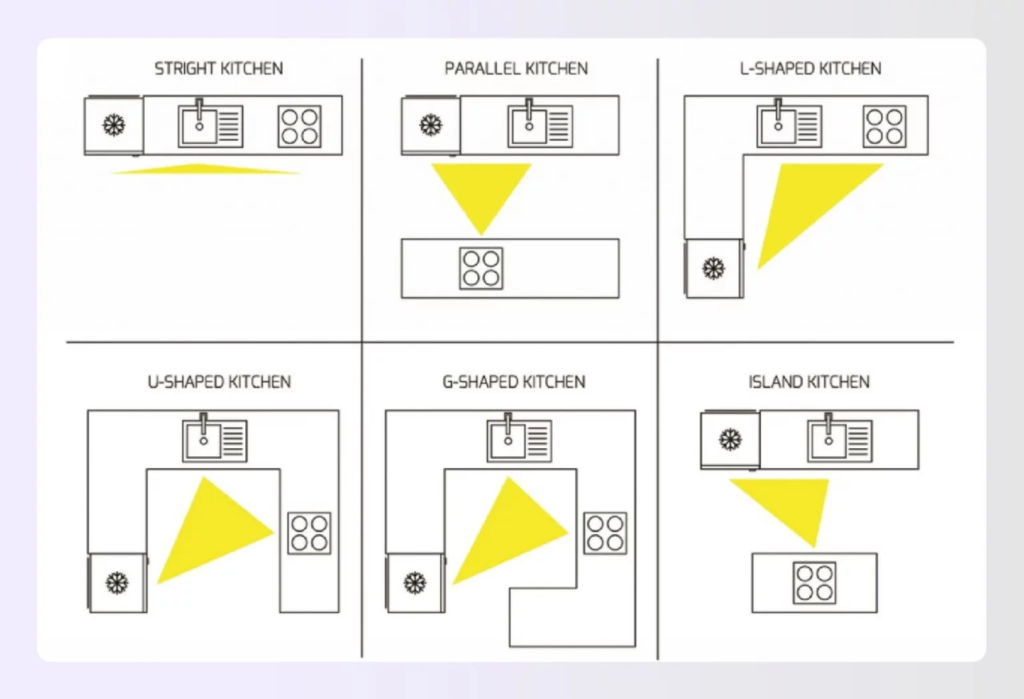
In modern kitchen design, visual appeal and functionality should go hand in hand. One of the fundamental principles commonly used in interior kitchen planning is the Kitchen Work Triangle. This concept focuses on the relationship between key work zones to create a more efficient and comfortable cooking environment.
The Kitchen Work Triangle connects three primary areas: the washing area (sink), the cooking area (cooktop), and the storage area (refrigerator). These zones form an imaginary triangle designed to reduce unnecessary movement during food preparation, cooking, and storage. When planned correctly, the kitchen feels more organized and supports a smooth daily workflow.
Key Principles for Applying the Kitchen Work Triangle
To ensure the system functions optimally, circulation between the three main zones should remain clear and unobstructed. Additional elements such as dining tables, chairs, or extra cabinetry should be positioned outside the primary work path to maintain an efficient flow.
User habits also play an important role in layout planning. Some households move frequently between the refrigerator and the cooktop, while others spend more time in the washing area. Adjusting distances and positioning based on these routines helps create a kitchen that is both ergonomic and personalized.
When the kitchen is integrated with other spaces, such as a dining or family area, the layout should still preserve the integrity of the Kitchen Work Triangle without interference from surrounding activities.
Applying the Kitchen Work Triangle Across Different Kitchen Layouts
The Kitchen Work Triangle is a flexible system that can be adapted to various kitchen configurations, as long as spatial proportions and circulation are carefully considered.
Linear Kitchen
In a linear kitchen, all kitchen elements are arranged along a single wall. This layout is commonly used in compact spaces. Since the work zones are aligned in one direction, careful spacing is essential to prevent overlapping movements during daily use.
Parallel Kitchen
A parallel kitchen utilizes two opposing walls with a circulation path in between. This configuration allows for a clearer separation of work zones and supports an efficient workflow without visual or physical obstructions.
L-Shaped Kitchen
An L-shaped kitchen features cabinetry along two perpendicular walls. This layout offers flexibility in arranging work zones. For safety and ease of movement, the cooking area should be placed on an accessible run rather than directly at the corner.
U-Shaped Kitchen
The U-shaped layout creates a focused work environment with generous countertop space. With the three main zones positioned close to one another, this configuration supports efficient movement and allows multiple users to work comfortably at the same time.
G-Shaped Kitchen
A G-shaped kitchen expands on the U-shaped layout by adding an extended countertop on one side. This additional surface can function as a casual dining area or an extra preparation space, while still maintaining a smooth workflow.
Island Kitchen
In an island kitchen, the island often serves as a preparation, cooking, or serving area. Strategic placement is essential to ensure the island complements the Kitchen Work Triangle and maintains comfortable circulation around all sides.
