

 Bahasa Indonesia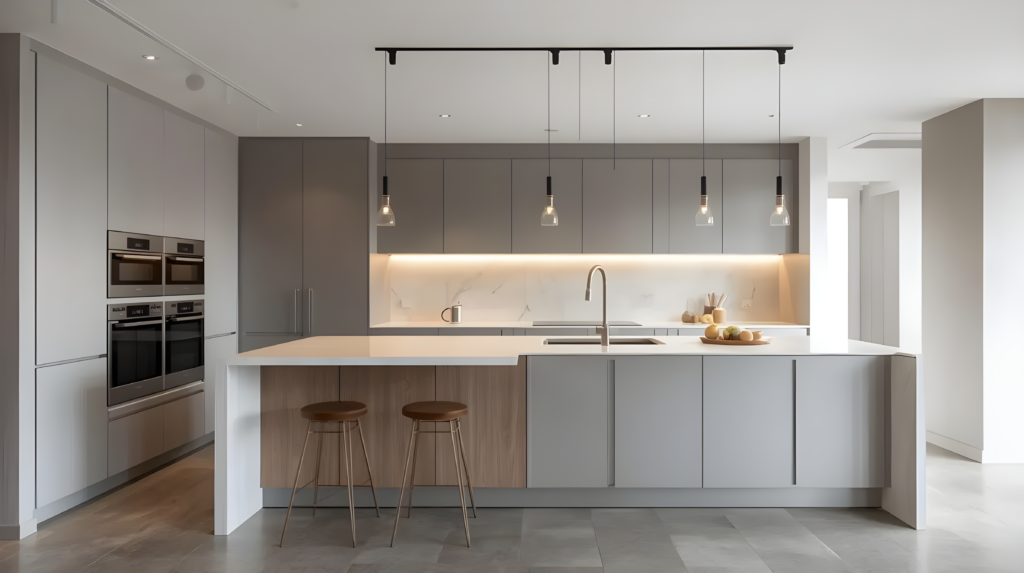
In today’s residential design, the kitchen is no longer treated as a purely functional space. It has evolved into a central area that reflects lifestyle, daily routines, and the overall visual identity of a home. Because of this shift, kitchen design now requires a careful balance between aesthetics, functionality, and technology.
Contemporary kitchen design responds to these needs through clean visual language, precise material selection, and efficient spatial systems. Below are key elements that define contemporary kitchens and remain highly relevant for modern interior planning.
1. Clean and Solid Material Exploration
Materials play a fundamental role in contemporary kitchen design. Stainless steel, glass, and natural stone are commonly used for their modern appearance, durability, and refined finish. Metallic touches on hardware and kitchen appliances reinforce a modern, slightly industrial feel, while natural or engineered stone introduces warmth and visual balance.
The focus is not only on how materials look, but also on how well they perform over time.
2. Open-Plan Layouts with Seamless Flow
Contemporary kitchens are often designed as part of an open-plan layout, connecting directly to dining or living areas. This approach creates a smooth transition between spaces and enhances the sense of openness within the home.
Beyond visual spaciousness, open kitchens also support social interaction, making them well-suited to modern lifestyles where cooking and gathering happen in the same shared area.
3. Technology as an Integrated Design Element
In contemporary kitchens, technology is not treated as an add-on, but as part of the overall design system. Smart kitchen appliances, automated lighting, and integrated control systems help improve efficiency while maintaining a clean, minimal appearance.
This integration allows the kitchen to function at a high level without adding visual clutter.
4. Lighting that Shapes the Atmosphere
Lighting plays a key role in defining the mood of a contemporary kitchen. Layered lighting—combining ambient, task, and accent lighting—is commonly used to support daily activities while enhancing the overall spatial experience.
Pendant lights with simple forms, concealed LED strips under cabinets, and focused lighting on kitchen islands help create a controlled, well-balanced atmosphere.
5. Neutral Color Palettes with Controlled Accents
Neutral tones such as white, grey, black, and beige dominate contemporary kitchens due to their timeless and calming qualities. To avoid a flat or monotonous look, accents are introduced in a measured way—through materials, textures, or selected details.
This approach keeps the space elegant while allowing subtle character to emerge.
6. Hidden and Efficient Storage Systems
Functionality is a core principle of contemporary kitchen design. Hidden storage, modular cabinetry, and smart organization systems help maintain a clean appearance even in frequently used kitchens.
Storage solutions are designed not only for capacity, but also for ease of access and ergonomic workflow.
7. Clean Lines and Geometric Composition
Strong visual identity in contemporary kitchens comes from the use of straight lines and clear geometric forms. Handle-less cabinets, sharp edges, and minimal backsplash patterns contribute to a structured and modern look.
These elements reinforce a sense of order and clarity throughout the space.
